What Is the Effect of Families Involvement in Social Activities
Introduction
On an international scale, parental interest in school has long been heralded as an important and positive variable on children's academic and socioemotional development. From an ecological framework, reciprocal positive interactions between these two cardinal socializing spheres – families and schools – contribute positively to a kid'due south socioemotional and cognitive development (Bronfenbrenner, 1987). Empirical findings have demonstrated a positive association between parental involvement in didactics and academic achievement (Pérez Sánchez et al., 2013; Tárraga et al., 2017), improving children'due south self-esteem and their academic performance (Garbacz et al., 2017) every bit well as school retention and omnipresence (Ross, 2016). Family involvement has likewise been establish to be associated with positive school attachment on the function of children (Alcalay et al., 2005) as well every bit positive school climates (Cowan et al., 2012). Research has also evidenced that programs focused on increasing parental involvement in educational activity have positive impacts on children, families, and schoolhouse communities (Jeynes, 2012; Catalano and Catalano, 2014).
Parent-schoolhouse partnership allows for the conceptualization of roles and relationships and the impact on the development of children in a broader way (Christenson and Reschly, 2010). From this approach, families and schools are the master actors in the structure of their roles and forms of involvement, generating new and varied deportment to relate to each other according to the specific educational context. The main findings in the family unit-school field show a positive influence of this partnership, contributing to academic accomplishment and performance, among other positive consequences (Epstein and Sander, 2000; Hotz and Pantano, 2015; Sebastian et al., 2017).
There is also strong support from international research showing the positive influence of parental interest over academic achievement, every bit has been demonstrated in a variety of meta-analyses across different populations and educational levels (Castro et al., 2015; Jeynes, 2016; Ma et al., 2016). Moreover, although there is a wide range of parental involvement definitions, some more full general and others more than specifics, there is a consensus among research results almost the positive influence of parental involvement over child academic achievement. For example, in the meta-synthesis of Wilder (2014), where nine meta-analyses are analyzed, this influence was consistent throughout the studies, regardless the different definitions and measures used.
However, most of the studies on parental involvement in didactics hail from anglophone countries and are based on cross-sectional and correlational designs (Garbacz et al., 2017) while in Latin America research remains scarce. In a recent systematic review of the literature on parental involvement in education in Latin America, only one Mexican study from 1998 was found which was also heavily influenced by interventions from the United States (Roth Eichin and Volante Beach, 2018). Chile has acknowledged the importance of collaborative relationships between families and schools developing a National Policy for Fathers, Mothers and Legal Guardians Participation in the Educational System (Política de Participación de Padres, Madres y Apoderados/as en el Sistema Educativo) in 2002 which was recently updated in 2017 (Ministerio de Educación, Gobierno de Republic of chile, 2017). Since the publication of this policy diverse local initiatives take sprouted in the country seeking to strengthen school family unit relations (Saracostti-Schwartzman, 2013). However, the majority of research in the land has thus far been of a qualitative nature with a focus on describing relations between family unit members and their schools, and identifying tensions between these two spheres (Gubbins, 2011).
Thus, this written report seeks to accelerate the assay of the effects of parental involvement in school on the academic achievement of Chilean students. The report aims to analyse how dissimilar parental involvement profiles (based on the main forms of parental involvement identified in literature) influence children's academic achieved. Parental involvement can accept a wide diversity of forms, amid them, communication between family and school, supporting learning activities at abode and involvement in school activities take been highlighted (Schueler et al., 2017), these are included in this written report using the scales proposed by Hoover-Dempsey and Sandler (2005).
Materials and Methods
Participants and Procedure
The study included 498 parents or guardians whose children attended 2nd and third form in 16 public schools with high levels of socioeconomical vulnerability (over 85% co-ordinate to official records of the schools) inside 3 different regions in Republic of chile (Libertador Bernando O'Higgins, Maule and Araucanía). Parents and guardians were aged between xx and 89 years old (Chiliad = 35.02, SD = 7.02 for parents, M = 59.27, SD = eleven.74 for grandparents and M = 43.14, SD = 15.41 for other guardians) and students betwixt 7 and 12 (M = 8.30, SD = 0.93). The bulk of them were mothers (83.9%). The majority of fathers and mothers had completed high school (33.one and 40.6%, respectively), followed by elementary didactics (28.i and 23.three%, respectively), no education completed (17.3% for both), professional title (vii.2 and 6.viii%, respectively) and academy championship (4.4 and 4.half-dozen%, respectively).
This study is part of a wider projection focusing on the effectiveness of interventions aimed at strengthening the link between families and schools. This study has the approval of the Ethics Committee of the Universidad de La Frontera and the Chilean National Commission for Scientific and Technological Inquiry (Acta 066-2017, Folio 036-17). Prior to information collection, after obtaining permission from the schools, informed consent forms were signed by the students' legal guardians to authorize their participation. The data referring to the students (evaluation of learning outcomes) was compiled through official school records. The data referring to the families (parental interest) was collected in paper format during parent teacher meetings at the cease of the schoolhouse yr considering their behavior during the preceding yr. Two enquiry assistants trained for this purpose were present for the applications.
Instruments
Parental interest was assessed using the five scales proposed by Hoover-Dempsey and Sandler (2005) that aim to mensurate the level of family unit involvement in children's teaching in elementary school from the indicate of view of the fathers, mothers and/or guardians. Scales have been adapted and validated by a panel of experts in Republic of chile (Reininger, 2014). Scales included in this study are: (one) Parental involvement activities at home [five items, such as "someone in this family (male parent, mother and/or guardian) helps the kid study for test" or "someone in this family (father, mother and/or guardian) practices spelling, math or other skills with the kid"]; (2) Parental involvement activities at school (v items, such as "someone in this family attends parent–teacher association meetings" or "someone in this family attends special events at school"), (3) Kid invitations for interest (five items, such us "my child asks me to talk with his or her teacher" or "my child asks me to supervise his or her homework"); (iv) Teacher invitations for involvement (half dozen items, such as "my child's teacher asks me to help out at school" or "my child'southward instructor asks me to talk with my kid about the school day"); and (five) General school invitations for involvement (six items, such as "this schoolhouse staff contact me promptly about any problem involving my child" or "parents' activities are scheduled at this school so that we can attend"). The first 4 scales have a four-point Likert response scale, that bespeak the frequency of the items, from 0 (never) to 3 (always). The last scale has a 5-point Likert scale response, indicating the grade of agreement with the items, from 1 (strongly disagree) to 5 (strongly concord). Scales tin can be consulted as Supplementary Tables 1–5. Internal consistency of all scales was adequate (α = 0.79, α = 0.72, α = 0.72, α = 0.85, and α = 0.87, respectively).
Students' academic achievement was evaluated thought the concluding boilerplate grade obtained at the end of the school year, recorded in a scale from i (minimum achievement) to seven (maximum achievement).
Results
Hierarchical cluster assay was used to identify parental involvement profiles based on the five subscales of parental involvement calibration (typified to avert the influence of the different scale responses), applying the standardized Euclidian Altitude method and using Ward's algorithm. Cluster analyses results showed that the optimal solution was the grouping of the participants into 3 groups. In Figure one the typified scores of each of the variables considered to calculate the groups are shown.
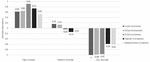
Effigy one. Parental involvement profiles.
To characterization the groups, nosotros examined the family interest profiles past computing a 1-way ANOVA on the standardized scores of the five parental interest scales with the clusters serving equally the factors. The result revealed that the clustering variables significantly differed between the involvement scales [Parental involvement at abode: F(2,497) = 147.83, p < 0.001, η2 = 0.37; Parental involvement at schoolhouse: F(2,497) = 148.82, p< 0.001, η2 = 0.38; Child invitation for involvement: F(2,497) = 225.34, p< 0.001, η2 = 0.48; Teacher invitation for involvement: F(2,497) = 84.77, p< 0.001, η2 = 0.26; General schoolhouse Invitation for interest: F(2,497) = 53.38, p< 0.001, η2 = 0.18]. Scheffe post hoc multiple comparisons showed the differences were statistically significant between all the parental involvement profiles in all variables, with the offset cluster scoring college than the second and the 3rd in all the scales, and the second higher that the third. Based on these differences and the scores, the first cluster was labeled every bit Loftier involved parents, representing 144 parents (28.9%) that scored above the mean in all the interest scales (from 0.54 to 0.91 standards deviations). The 2nd cluster was named Medium involved parents, including 228 parents (45.8%) that accept scores close to the media in all the interest scales (from -0.14 to 0.16 standards deviations). Finally, the third cluster was classified as Depression involved parents, including 126 parents (25.3%) that scored below the mean in all the involvement scales (from -0.61 to -0.91 standards deviations). Tabular array 1 shows demographic data for the clusters.
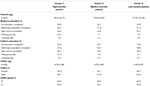
Table i. Demographic information of the clusters.
Finally, ANOVA results showed that there were significant differences in academic achievement scores between the 3 clusters of parent involvement profiles, F(2,430) = 5.37, p = 0.003, η2 = 0.03. Scheffe post hoc multiple comparisons showed that high (One thousand = 5.97, SD = 0.49) and medium (Yard = 6.00, SD = 0.50) involved parents had children with higher academic accomplishment than depression involved parents (Grand = five.8, SD = 0.47). Complementarily, results from correlations between parental involvement and academic achievement scores support these results, showing a meaning and positive correlation(r = 0.14, p = 0.003).
Give-and-take
From the results presented, nosotros can conclude the existence of three different profiles of parental involvement (high, medium and low) considering dissimilar scales of parental involvement (at home, at schoolhouse and through the invitations fabricated by the children, the teachers and the school). Secondly, results showed that in that location were differences in academic achievement scores between the parent interest profiles, where high and medium involved parents had children with higher academic achievement than low involved parents.
As shown, international literature reveals that the degree of parental interest is a disquisitional element in the bookish achievements of children, specially during their first school years highlighting the need to generate scientific evidence from the Chilean context. Most of the studies in this area come from anglophone countries (Garbacz et al., 2017) while in the Latin American context enquiry is still scarce. Results from our report approve that parental interest tin contribute alike in other cultural contexts, pointing to the need to also implement policies to promote it.
In this context, Chile has best-selling the importance of collaborative relationships between parents and schools leading to the development a National Policy for Father, Mother and Legal Guardian Participation. Nevertheless, nigh of the research in the country has thus far been of a qualitative nature with a focus on describing family-school relations and identifying tensions between these 2 spheres (Gubbins, 2011). Thus, this study seeks to make progress in the analysis of the effect of parental interest and children'southward and academic achievements of Chilean students.
Ethics Argument
This study was carried out in accord with the recommendations of the Chilean National Committee for Scientific and Technological Research with written informed consent from all subjects. All subjects gave written informed consent in accordance with the Proclamation of Helsinki. The protocol was approved past the Ethics Commission of the Universidad de La Frontera and the Chilean National Commission for Scientific and Technological Research.
Author Contributions
MS adult the study concept and the study design. LL substantially contributed to the written report concept, and performed the data assay and estimation. MS and LL drafted the manuscript. All the authors canonical the final version of the manuscript. They also agreed to be accountable for all aspects of the work.
Funding
This piece of work was supported past FONDECYT 1170078 of the National Commission for Scientific and Technological Research of Chile.
Disharmonize of Interest Argument
The authors declare that the research was conducted in the absence of whatsoever commercial or financial relationships that could exist construed as a potential disharmonize of interest.
Supplementary Material
The Supplementary Cloth for this article can exist establish online at: https://www.frontiersin.org/articles/x.3389/fpsyg.2019.01464/full#supplementary-fabric.
References
Alcalay, L., Milicic, North., and Toretti, A. (2005). Alianza efectiva familia-escuela: united nations programa audiovisual para padres. Psychke 14, 149–161. doi: ten.4067/S0718-22282005000200012
CrossRef Full Text | Google Scholar
Bronfenbrenner, U. (1987). La Ecología del Desarrollo Humano. Barcelona: Ediciones Paidós Ibérica.
Google Scholar
Castro, Grand., Expósito-Casas, E., López-Martín, Eastward., Lizasoain, Fifty., Navarro-Asencio, E., and Gaviria, J. J. (2015). Parental interest on student academic accomplishment: a meta-assay. Educ. Res. Rev. xiv, 33–46. doi: 10.1016/j.edurev.2015.01.002
CrossRef Total Text | Google Scholar
Catalano, H., and Catalano, C. (2014). The importance of the school-family unit relationship in the child'south intellectual and social development. Proc. Soc. Behav. Sci. 128, 406–414. doi: 10.1016/j.sbspro.2014.03.179
PubMed Abstract | CrossRef Full Text | Google Scholar
Christenson, Due south. L., and Reschly, A. L. (2010). Handbook of School-Family Partnerships. New York, NY: Routledge.
Google Scholar
Cowan, Grand., Bobby, Grand., St. Roseman, P., and Echandia, A. (2012). Evaluation Study: The Abode Visit Project. ERIC database No. ED466018.
Google Scholar
Epstein, J. L., and Sander, Yard. (2000). Handbook of the Sociologic of Education. New York, NY: Springer.
Google Scholar
Garbacz, Southward. A., Herman, K. C., Thompson, A. M., and Reinke, W. K. (2017). Family date in education and intervention: implementation and evaluation to maximize family, school, and pupil outcomes. J. Sch. Psychol. 62, 1–10. doi: x.1016/j.jsp.2017.04.002
PubMed Abstract | CrossRef Full Text | Google Scholar
Gubbins, 5. (2011). Estrategias de Involucramiento Parental de Estudiantes con Buen Rendimiento Escolar en Educación Básica. Doctoral dissertation, Pontificia Universidad Catolica de Republic of chile, Santiago.
Google Scholar
Hoover-Dempsey, One thousand., and Sandler, H. (2005). The Social Context of Parental Involvement: A Path to Enhanced Achievement. Final Study OERI/IES grant No. R305T010673. Nashville, TN: Vanderbilt University.
Google Scholar
Jeynes, Westward. H. (2012). A Meta-Analysis of the efficacy of unlike types of parental interest programs for urban students. Urban Educ. 47, 706–742. doi: ten.1177/0042085912445643
CrossRef Total Text | Google Scholar
Jeynes, Westward. H. (2016). A Meta-Analysis: the relationship between parental involvement and Latino pupil outcomes. Educ. Urban Soc. 49, 4–28. doi: 10.1177/0013124516630596
CrossRef Full Text | Google Scholar
Ma, X., Shen, J., Krenn, H. Y., Hu, Southward., and Yuan, J. (2016). A Meta-Analysis of the relationship betwixt learning outcomes and parental involvement during early babyhood didactics and early elementary education. Educ. Psychol. Rev. 28, 771–801. doi: x.1007/s10648-015-9351-1
CrossRef Full Text | Google Scholar
Pérez Sánchez, C. N., Betancort Montesinos, M., and Cabrera Rodríguez, L. (2013). Family influences in academic achievement: a report of the Canary Islands. Rev. Int. Sociol. 71, 169–187. doi: 10.3989/ris.2011.04.11
CrossRef Full Text | Google Scholar
Reininger, T. (2014). Parental Involvement in Municipal Schools in Republic of chile: Why do Parents Cull to get Involved? Ph.D. dissertation, Fordham University Graduate School of Social Service, New York, NY.
Google Scholar
Ross, T. (2016). The differential effects of parental involvement on high schoolhouse completion and postsecondary attendance. Educ. Policy Anal. Arch. 24, ane–38. doi: ten.14507/epaa.v24.2030
CrossRef Total Text | Google Scholar
Roth Eichin, N., and Volante Beach, P. (2018). Liderando alianzas entre escuelas, familias y comunidades: una revisión sistemática. Rev. Complut. Educ. 29, 595–611. doi: x.5209/RCED.53526
CrossRef Full Text | Google Scholar
Saracostti-Schwartzman, Yard. (2013). Familia, Escuela y Comunidad I: Una Alianza Necesaria Para un Modelo de Intervención biopsicosocial Positive. Santiago: Editorial Universitaria.
Google Scholar
Schueler, B. E., McIntyre, J. C., and Gehlbach, H. (2017). Measuring parent perceptions of family–schoolhouse engagement: the development of new survey tools. Sch. Commun. J. 27, 275–301.
Google Scholar
Sebastian, J., Moon, J.-M., and Cunningham, Grand. (2017). The Relationship of school-based parental involvement with student achievement: a comparing of master and parent survey reports from PISA 2012. Educ. Stud. 43, 123–146. doi: 10.1080/03055698.2016.1248900
CrossRef Full Text | Google Scholar
Tárraga, V., García, B., and Reyes, J. (2017). Home-based family interest and academic achievement: a case written report in main teaching. Educ. Stud. 44, 361–375. doi: x.1080/03055698.2017.1373636
CrossRef Full Text | Google Scholar
Wilder, Southward. (2014). Effects of parental interest on academic achievement: a meta-synthesis. Educ. Rev. 66, 377–397. doi: 10.1080/00131911.2013.780009
CrossRef Full Text | Google Scholar
Source: https://www.frontiersin.org/articles/10.3389/fpsyg.2019.01464/full
0 Response to "What Is the Effect of Families Involvement in Social Activities"
Post a Comment